In my apartment up the valley in Murray, I stood in front of the bathroom mirror and treated dressing like an ordnance assembly.
Miller was an awkward wreck around women, but he was not an idiot. You do not spend twenty years in the building, six of them parsing East European traffic in a basement bunker, without a hyper-tuned eye for discrepancies. If I showed up in Draper looking like an operative running a honey trap, his analytical circuits would scream. He would retreat into bureaucratic paranoia, clamp his jaw shut, and report me to counterintelligence by morning.
Everything had to feel sloppy, accidental, and utterly organic.
It had to look like an athletic woman who threw on whatever was clean, drove off the reservation because she was lonely, and possessed no filter between her thoughts and her body.
I pulled a bra from the bottom of my lingerie drawer that had spent eight months in exile. Italian demi-cup, Fort Collins consignment rack, a mistake the first time I wore it. The cups sat so low they were an argument against the category. Underwire below the breast more than around it. Silk that didn't climb high enough to hide anything it was sold to hide. Take a breath, lean, lift an arm, and there was no top ridge left to fail. The thing had already surrendered. Pale skin, the dark of the aureole, the whole front of me hanging over a band that might as well not have been there.
I had stopped wearing it because it was a public hazard.
Tonight, it was payload delivery.
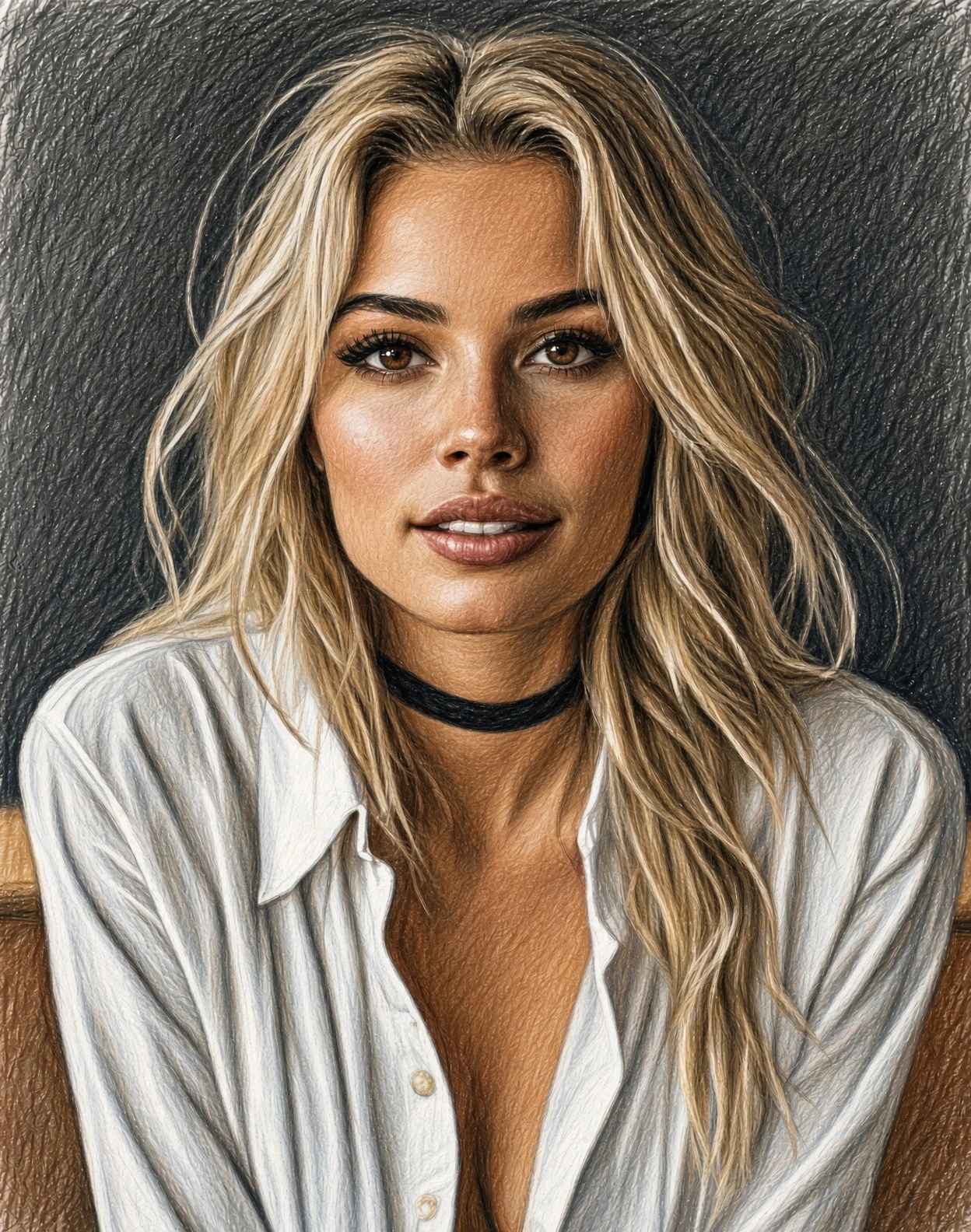
Over it, I pulled on a white button-down I had bought for four dollars at a thrift shop in Grand Junction. Collar, long sleeves, cheap pearly buttons. I left most of them undone so the shirt hung open to the sternum. Upright, it still showed the inner slopes and the black choker at my throat. Lean across a booth for a salt shaker and the shirt stopped pretending it had a job.
The choker was a thin black band, fitted, nothing precious about it. The shirt on its own was borrowed from menswear: unbuttoned, sloppy, the kind of thing you could swear you grabbed off a chair. The band ruined that alibi just enough. It sat right above the open space and drew a hard line at my throat, framed the collarbones, and sent the eye up to my face instead of letting it fall and stay. Soft cloth, sharp ring. Clean silhouette with one dark break in it. I did not need the thing to mean anything secret. I needed it to look like I knew how the pieces sat on me, and that I knew they would catch. Innocent if you wanted it to be. Daring if you were sitting across the booth doing the math. Extra kick. A decision, not laundry.
Down below, I chose a pair of faded low-rise denim jeans that sat low on my hips, held up by nothing. When I leaned forward or twisted in an upholstered seat, the waistband dipped two inches, showing the sharp V of my hip bone and the black lace edge of my hipsters.
I left my hair down. Long, loose, ash-blonde waves over the white shirt and the choker, the way it fell when I didn't bother with a tie. I checked my brown eyes in the glass and stepped back.
It was lethal because it looked effortless.
I didn't feel cheap doing it. I didn't feel nervous. I used to swim. Hard. Competitively. With girls who were going to get looked at by colleges and coaches who didn't care if your lungs burned. A two-hundred individual medley will teach you what to do with fear: you put your toes on the block, you wait for the horn, and you go. That was the temperature in the mirror. Same quiet. Same body, pointed at a time.
The rest was leverage. Miller had a weakness in his firewall. I was going to use it.
I wasn't cheating. There was a man. We were both Type A to the bone — the kind of people who got bored if the room wasn't moving — and we had never tried to crush that into one address. Neither of us suffered from juvenile jealousy. We were equals. Parallel orbits. He ran his life at full speed. I ran mine. If he knew I was sitting in a booth across from a basement analyst to crack a state secret, he wouldn't have called it a betrayal. He would have checked the perimeter and timed my egress. A night in Draper wasn't going to be news he couldn't handle.
I drove down to Draper in silence, leaving my government phone in a Faraday pouch inside the glove box.
The steakhouse was tucked into a strip of dark cedar buildings off the highway, far enough past the last checkpoint to feel civilian, close enough to the foothills to be quiet. Inside, the lights were low, the leather booths were high-backed and dark, and the smell of charred ribeye and bourbon hung heavy in the warm air.
Miller was already there, sitting in a corner booth, looking like an inmate granted twenty minutes of parole.
He had tried. God, he had tried.
He wore a light blue button-down shirt that was starched into stiff cardboard, creased with fresh iron marks, and reeked of commercial dry-cleaning fluid and old cedar closet blocks. His thin neck swam inside the wide collar, and his wire-rimmed glasses were pushed so tight against the bridge of his nose that they left deep red dents in his skin. He was turning a paper napkin into shredded ribbons with his pale, ink-stained fingers.
When he saw me walking across the dining room, his jaw actually went slack.
I didn't walk fast. I let the relaxed, rolling stride of a six-foot swimmer carry me through the dim room. A businessman at the bar stopped mid-sentence to watch me pass. Miller looked as if he were watching an angel drop into a trench.
"Krystyna," he croaked, scrambling to stand up. His right knee slammed violently into the underside of the heavy oak table, rattling the silverware and sloshing ice water over his water glass. "Oh, damn it. Sorry. Hey."
"Sit down, Miller," I said, offering a warm, conspiratorial laugh that put him instantly at ease. "You're going to knock the house down."
I slid into the opposite side of the booth, intentionally sitting slightly sideways so the line of my low-rise denim pulled tight against my hip. The candlelight caught the white shirt and the open placket and the black band at my throat. There was no lace to outline. There was skin.
Miller swallowed hard, his eyes dropping to the open collar of my shirt before snapping back to my forehead with panicked discipline. "You... you look great. Really great. It's weird seeing you without the badge lanyard."
"It's weird being outside that concrete hole," I said, resting my chin in my palm and looking directly into his pupils. "The air up there on the fourth floor smells like an operating room. I needed to see someone who didn't talk like an audio recording."
The waitress appeared, and I ordered a double bourbon, neat, without looking at the menu. Miller, thrown completely off script, stammered and asked for a draft IPA.
When the drinks arrived, I took a slow sip, letting the amber fire hit my throat, and leaned back into the leather. "So, tell me. How long has the basement been eating you alive, Miller?"
He looked into his beer foam, his shoulders sinking half an inch into the cardboard collar. "Six years here. Before that, Meade. A long time before that."
"You live in the valley?"
"South Jordan," he muttered, turning his glass in a wet circle. "Two-bedroom apartment. Nothing fancy. Just... books, mostly. And my desktop rig."
"No wife?" I asked, keeping my tone curious, entirely free of pity.
A bitter, exhausted shadow crossed his mouth. "Not anymore. Four years ago. She... she couldn't take the lifestyle. You know how it is. You sign the NDA, you leave your phone at the gate, you can't tell them why you're home at three in the morning smelling of grease and ozone. She thought I was cheating. Then she realized it was worse: she realized I was just disappearing."
He looked up at me, his eyes naked and stripped of any defense. "Most people don't survive that building with a soul intact, Krystyna."
"Is that why you panicked when I ran that query?"
The temperature at the table dropped ten degrees in a fraction of a second.
Miller didn't just freeze; he flinched, pulling his hands entirely off the table and tucking them into his lap as if the wood were electrified. The awkward, blushing schoolboy vanished, replaced instantly by the cold, survival-hardened instincts of a man who had kept his security clearance through three administrative purges.
"Don't," he whispered, his voice hard, flat, and defensive. "I agreed to dinner because I thought you were just tired of the cafeteria. If this is an off-reservation fishing trip, I'm getting in my car right now."
He actually shifted his weight toward the edge of the booth, preparing to slide out. The walls were slamming up. Fear of federal prison was screaming in his ear, overriding the alcohol and the romantic fantasy.
I didn't flinch, and I didn't back off. I escalated.
"Miller, stop," I said, pitching my voice low and brittle, letting the smooth confidence crack into something fragile and desperate. "Look at me."
He hesitated, glaring at the salt cellar, his jaw clamped tight.
I planted my elbows on the table and leaned forward, chin in my hands. The shirt, which had been waiting for this job all night, slipped forward on cue. Cool air hit my nipple. It was hanging free well above the bra, an inch from the open placket, one stupid breath from showing. The smooth, creamy inside of my breast was already on display. If Miller stood up and looked down he would have seen the whole thing, nipple and all. I found myself enjoying the thrill. Men can get used to a nude beach. They never get used to a shirt that might still do something.
Miller looked up to deliver another refusal, and the words died in his throat.
Don't make me push this further, Miller, I thought, watching his throat bob convulsively as his analytical circuits completely seized. Just tell me what you know.
A quiet, amused smile tugged at the back of my mind as his resistance started to buckle. It wasn't that I dreaded the alternative. In fact, the thought of where this could go was almost entertaining. If the dinner didn't crack him, the contingency was already mapped out: lingering in the gravel lot outside, leaning back against the cold hood of his beat-up Honda, letting the tension simmer until he had no choice but to invite me in.
From there, taking total command would have been child's play. The poor guy hadn't been close to a woman in four years; he would have been completely paralyzed, breathless, and clinging to the upholstery while I ran the entire show until his brain short-circuited entirely. He’d probably walk into the bullpen tomorrow morning feeling like a brand-new man with a completely ruined worldview. I almost chuckled at the mental image. It would have been effortless fun, but getting the answers right here over bourbon saved us both a lot of complicated logistics.
"They quarantined me, Miller," I whispered, reaching my fingers across the gap and pressing them directly over the back of his cold, rigid hand. "I have Elena watching every keystroke from behind a plate glass wall. They're running civilian news through an automated script, and the same token I showed you is being forced into the wire feeds before morning syndication."
My fingers tightened around his. "I'm not fishing for a promotion. I'm terrified. If you walk out that door, I have nobody."
That was the fatal strike.
I didn't attack his intelligence; I validated his manhood. I gave an isolated, discarded man the one narcotic he couldn't refuse: being the sole protector of something beautiful.
Miller let out a long, ragged exhale that sounded like air escaping a punctured tire. The defensive hardness melted out of his shoulders, leaving him slumped, exhausted, and completely broken open. He turned his hand over and curled his fingers tightly around mine.
"Caldwell," he whispered, his eyes rimmed with red under his thick lenses.
"Who was Caldwell?"
"He sat at station forty-two," Miller murmured, his gaze darting toward the floor as if checking for microphone grilles. "Three years ago. Language analytics. He was running a predictive model on the Ukraine problem set — the '22 wires, the ones that never really went quiet — and caught a statistical ghost in the transmissions. Same token anomaly. Same rhythmic spacing."
"What happened to him?"
"He thought it was an undocumented watermark," Miller said, his voice dropping so low I had to lean even closer to catch the syllables. "He submitted three diagnostic tickets through the section queue, asking for an architectural review. After that the floor story was two men. They didn't yell. They didn't show badges. They just told him to leave his jacket on the back of his chair."
"Did he get reassigned?"
"His credentials were wiped from the central directory by noon," Miller said, his grip on my hand tightening until it almost bruised. "The memo called it Title 50 and a psychological episode. Voluntary medical leave. That was the paper. His apartment in Lehi was cleared out by the county two weeks later. His car was abandoned at the long-term lot at Salt Lake International. He ceased to exist, Krystyna."
A cold, electric current moved through my bloodstream, raising the fine hairs along my forearms.
"Why the mark, Miller? Why that token?"
Miller swallowed hard, his eyes finally lifting from my chest to meet my gaze with pure, unvarnished dread.
"Because you can strip metadata, alter timestamps, and route IP headers through six encrypted hops, but human syntax has to remain legible," he said. "It isn't a code you read with your eyes. It's a carrier beacon. A tag in the language itself. Whenever narrative material is generated or rewritten by the synthesis engine upstairs, the token gets inserted."
"To track what?"
"Saturation," Miller breathed. "They don't care if people believe the news. They only care how much of the global information bloodstream has passed through the machine. If the mark is there, the machine touched it. Once the mark reaches eighty percent density across news, blogs, and social posts, they know the population's mind has been conditioned for whatever comes next."
He took a shaky breath, leaning so close I could smell the stale malt on his lips.
"What's the project name, Miller?"
"Project 2014," he whispered.
"Why 2014?"
Miller gave a faint, helpless shrug, his fingers trembling in mine.
"I don't know," he muttered, staring blankly at our hands on the table. "Nobody knows. Some budget year? An executive order from a decade ago? It's just what Caldwell saw on the internal routing manifests before they scrubbed him."