I left Miller in the booth with half a pint of IPA and drove north.
Draper fell off the back of the car. State Street ran like a dirty fluorescent tube up the valley. To the east the Wasatch was a black saw. To the west the lights of the basin thinned toward the lake. No desert. No county line to collect. Just eleven-something and a white shirt that still smelled like steakhouse air and my own pulse.
The apartment was second floor, Murray, beige fiber-cement, the kind of stack that rented to traveling nurses and men who kept their lives in Pelican cases. Nobody asked a surname. I badged the stairwell, pulled the blinds, and stood in the dark until the refrigerator hummed loud enough to be a person.
Boots off. Keys on the laminate. Tap water in three swallows.
The government phone stayed in the glove box, two layers of copper mesh, where it belonged. Bring that brick within thirty feet of an unvetted network and it logged every Wi-Fi name in the building and coughed a quiet ping at the regional desk before you turned the deadbolt. Half the bullpen called it diagnostic. The other half left the thing in the car and slept.
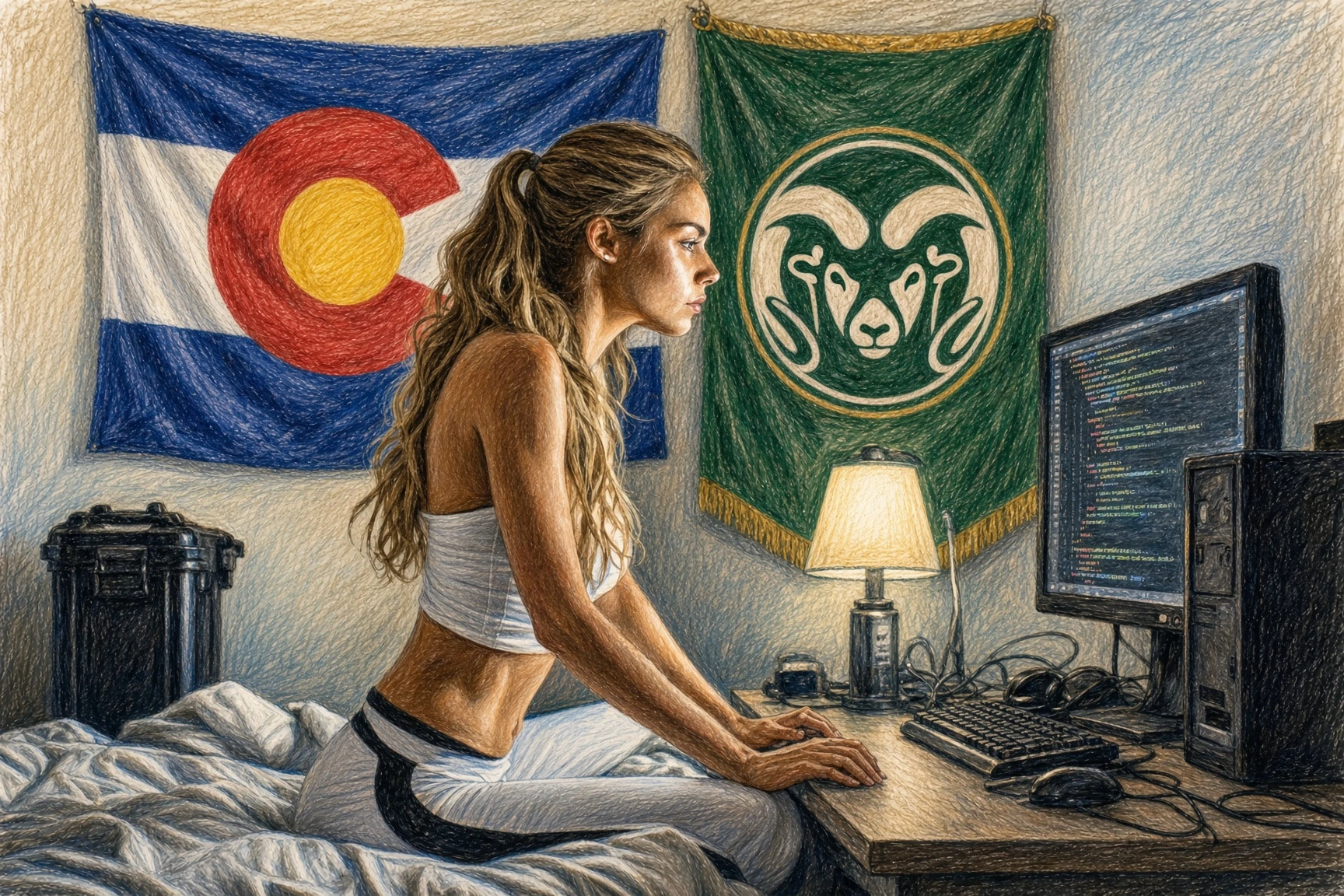
I stripped the steakhouse shirt, pulled on a white sports bra and thin pants, and went into the spare room. Mattress on a low frame. Steel table. One lamp. One monitor. The unbranded tower I had built from cash parts in Grand Junction and Provo. Pelican case in the corner. On the wall, because this was still my life and not only the job: a Colorado flag that hung true, and next to it the green CSU Rams banner from the years in Fort Collins. No wireless card. No Bluetooth. No mic header. Linux off a disc that forgot the RAM when the switch went down. A cold machine.
I knelt on the bed so I could reach the board on the table, waited for the desktop to come up black, and plugged in the enclosure: two terabytes of RFCs, old telecom dumps, Unicode pubs, anything I had pulled off the public web over four years and never trusted to a cloud.
Miller was still in my head. Not the shirt. The name.
Project 2014.
He had sworn he didn't know why. Only that Caldwell had pulled a string, and within a couple of days the chair was empty and the furniture was on a curb in Lehi.
I opened a text editor and typed it.
2014
NSA programs came dressed. PRISM. STELLARWIND. TEMPEST. Two words, or a myth you could put on a slide. Air Force and DIA bought things with AN/FSQ and MIL-STD and Big Safari line items. A naked four-digit integer was the kind of label a coder left on a whiteboard when the colonels weren't in the room.
I grepped the local store the way you grep a crime.
MIL-STD-2014. Dead. FIPS 201-4 was PIV badges, plastic and pins, nothing that ate a Gulf firehose. Lucent 5ESS docs. BGP AS numbers. Old ARPANET host tables. Tank manuals. Baud rates. I burned an hour proving the number was not a radio and not a rifle.
Then I stopped asking the military what 2014 meant and asked the character set.
Token-ID 8413 had been a count. A density. A thing my parser had been willing to print when I hadn't asked it to. Project 2014 was a name Caldwell had seen on a routing manifest. If they were the same animal, the name had to live somewhere a machine already understood.
I loaded the Unicode pubs. ASCII first, because that was the cage. Seven bits. A hundred and twenty-eight slots. Letters, numbers, a hyphen on 0x2D. If a writer wanted a pause they hit the key twice. There was no room in that cage for a typesetter's long dash. The men who built it were saving drum space, not cadence.
The long dash arrived later, when the committees in the late eighties decided the planet needed one ledger for every mark a human hand had ever made. Xerox. Apple. Metaphor. Linguists. Font people. And, in the appendices, the fingerprints that made my mouth go dry: Bell Labs. IBM Federal. DEC. BBN, the shop that had built the switches the first internet actually ran on. Not poets. The people who had spent their lives putting ears on cables.
I opened the General Punctuation block and scrolled.
Spaces. Hair space. Thin space. Figure dash. En dash.
Then the row that ended the night.
U+2014
EM DASH
UTF-8: E2 80 94
I laughed once, no humor in it, and the sound was too loud in the room.
Project 2014 was not a budget year. It was not an order signed in an election. It was the code point. The address of the mark. Token-ID 8413 had been counting how often that address appeared. I had been staring at the glyph for two weeks and calling it a column header.
A car went by on the interstate. Headlights dragged across the ceiling and were gone.
I pulled the 1990 minutes, the subcommittee that had nailed the punctuation block down in Mountain View. Early European drafts had wanted the software to guess: hyphen or minus or en or em, depending on the words around the stroke, so you could keep shipping seven-bit text. The American defense and telecom people killed that. Every mark got its own permanent slot. No collapsing in compression. No stripping in a gateway. If a file contained an em dash, those three bytes had to survive every operating system and every tap between a mouth and a screen.
They were not defending printing houses.
They were reserving spectrum.
You can wipe EXIF. You can boil a PDF until the author tag is gone. You can bounce a packet through six encrypted hops and make it look like a cafe in Bucharest. You cannot strip the words and still have a message. People read nouns. They ride over punctuation like it is weather. A SIGINT parser on a fiber in Utah does not ride. It counts. One mark. One confirmation. The engine was here.
The same cold I used to get on a pool deck before a heat went up my back. Chlorine. Quiet pressure. Toes on tile.
I reached for the mouse to kill the window.
A click came from the hall closet.
Small. Distinct. Not the building. Not the fridge.
I took my hand off the mouse. Pulse in the neck. The closet was the demarc: fiber jack, breaker panel, the cheap cable gateway the telco had left so the apartment would look like an apartment. Bridge mode. I did not use it. I left it lit so that if anyone cared they would see an ordinary tenant with an iPad and a streaming habit.
I came off the bed without noise and moved the way I had learned on trails above the Colorado, heel to toe, weight quiet. The only light was the lamp behind me falling into the hall. I opened the closet two inches.
The gateway's LEDs were not bored. They were working. Downstream amber locked solid. The rest of the array stuttering in bursts that did not belong to a movie buffer at two in the morning.
Somebody was talking to my MAC.
Could have been the provider. A noise check. The story you get if you call the 800 number and enjoy hold music.
Or Halvorsen had fed a lease and a plate into a domestic queue the morning my badge died, and they were sniffing the apartment to see whether the quarantined analyst was asleep or digging.
They would not send a Suburban. Not for this. Not yet. They would watch the lights.
The tower in the other room could not leak. It had nothing to leak with. Paranoia did not care. Paranoia filled the hallway and turned the floor into a person.
I reached behind the gateway and pulled the power.
The LEDs died. The closet went black.
I stood there a full minute. Hands steady. Colorado. Or training. Or both. Dark is also a signal. I knew that. I pulled it anyway.
Miller had been right to go white over three letters.
Project 2014 was not a footnote. It had an address. It had a pulse. And the pulse reached past Camp Williams, past Elena's glass, into a closet in Murray.
I could not finish this from a folding table.
I had to go into the wild.