I left my rental car locked beneath the amber sodium lights of the steakhouse lot and climbed into the passenger seat of Miller’s 2008 Honda Civic.
The interior smelled of old upholstery foam, cold dashboard vinyl, and the faint, bitter metallic tang of unburned exhaust coming through the floorboards. The blower motor on the heater was completely dead; cold desert air seeped through the window seals as we turned north onto the frontage road. In the cramped footwell, my long legs were jammed at an angle against the plastic center console, my right knee inches from the worn rubber shift knob.
Miller drove with both hands welded to the ten-and-two position on the wheel, his knuckles bleached white under the intermittent flicker of highway streetlights.
He didn't speak. He checked his side mirror every eight seconds with the mechanical cadence of a pilot running emergency descent checklists. He was waiting for the black grilles of federal pursuit to appear behind us, waiting for the sky to fall because he had whispered the word treason inside a commercial restaurant.
I reached over, rested my right hand firmly over his rigid fingers on the gear shift, and gave him a calm, steady squeeze.
"Breathe, Miller," I said, my voice cutting through the rattle of the engine. "Nobody followed us out of the lot. You're driving your car on a public road on a Tuesday night. Look at the road."
He swallowed hard, his chest shuddering as he drew in a long, ragged breath through his teeth. "You don't understand how fast the net drops, Krystyna. When they decide you're a vector, you don't get a siren. You just run out of road."
"Then we make our own road," I said. "Keep driving."
His apartment was in a sprawling, beige garden-style complex off Redwood Road in South Jordan, tucked behind an endless row of identical three-story stucco facades. We parked in a dark covered stall near the perimeter fence. When he cut the ignition, the sudden silence inside the car was deafening.
We took the exterior metal stairs in the dark, our boots ringing softly against the industrial treads. Miller unlocked the deadbolt with a trembling brass key and pushed the door open into a room that felt less like a home and more like a monk's cell in an abandoned monastery.
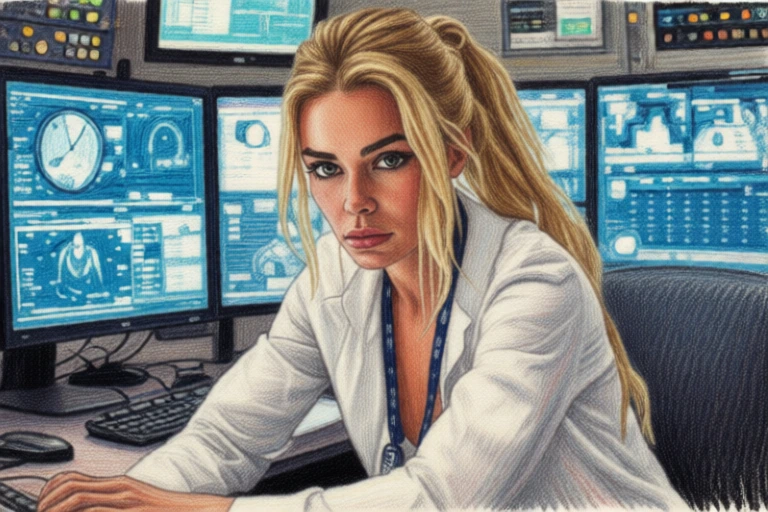
The living room was carpeted in commercial industrial pile that had never seen a pair of muddy boots. There were no photographs on the walls. No framed art. No plants. The only furniture was a sagging brown microfiber sofa, an unvarnished plywood bookcase stacked two rows deep with cryptographic manuals and Soviet telecom histories, and a massive L-shaped steel desk in the corner dominating the entire room.
On the desk sat three 32-inch matte monitors hooked into a custom water-cooled tower rig that hummed with a low, clean pitch. Two mechanical keyboards with blank, unprinted keycaps sat on oversized felt desk pads. The only light in the apartment came from the soft blue status LEDs pulsing along the front edge of his network switch.
Miller stood in the center of the kitchen tile, his corduroy jacket still zipped to his collar, looking around his own living room as if he had just brought an unexploded artillery shell into the kitchen.
"I can... I can make tea," he stammered, his eyes darting from the sink to the bookcase. "Or water. I have tap water. I don't really keep much in the fridge because the shifts down in Level B make buying groceries kind of pointless."
He was retreating into small talk again, desperate for any domestic ritual that could hide the terrifying fact that he had crossed the Rubicon.
I unbuttoned my leather coat, draped it over the back of a metal folding chair, and stepped into his space. In the dim blue glow of the server LEDs, my charcoal wool turtleneck and dark trousers made me look tall, severe, and utterly out of place against his neglected bachelor squalor.
"Miller," I said softly, walking directly up to him on the tile until his face was six inches from mine. "Look at this room."
He blinked, frozen in his tracks, his breath hitching in his throat.
"Look at where you live," I said, gesturing toward the empty walls and the humming tower. "You gave six years of your life to that concrete hole in the desert. You let them hollow you out until you stopped buying food, stopped talking to your friends, and forgot what it felt like to exist in the sun. And you're standing in your own apartment shaking like a terrified child because you finally decided to act like a man."
His jaw worked, his mouth opening and closing as the raw truth of it hit him square in the ribs. "I'm not a hero, Krystyna."
"I don't need a hero," I said, reaching up and resting my palms flat against the rough corduroy of his chest, feeling the wild, rabbit-fast thump of his heart beneath the cloth. "I need an engineer with a pulse. Show me the topology."
That word snapped his focus like a whip crack.
The stammering boy vanished. Miller pulled out of my touch, stepped over to the desk, and hit the power switch on his primary terminal. Three huge monitors lit up simultaneously, washing his pale, angular face in clean white phosphor. He pulled a rolling task chair out, sat down, and began typing with blistering, rhythmic speed, the mechanical key switches clacking like dry bamboo in the quiet room.
I leaned over his shoulder, placing one hand on the cold steel edge of the desk, my arm brushing against his upper arm as he opened an encrypted network mapping canvas.
"Here," he said, pointing a blunt finger at a complex vector diagram showing autonomous system routing nodes across the western United States. "The commercial AI clusters on the proving grounds don't connect directly to the public internet. They route through three carrier-neutral transit facilities: one in Salt Lake City, one in Boise, and one at the edge of the Hanford reservation."
His voice had transformed completely. The hesitation, the self-pity, the clumsy social paralysis had vanished into thin air. He was speaking with the absolute, undisputed authority of a master craftsman reading an architectural blueprint.
"The optical taps inside the Utah Data Center sit on the return loop," he explained, tracing a dotted blue vector with his cursor. "When an end-user sends a prompt from an app on their phone, the commercial model generates the raw synthetic text. Before that packet reaches the public gateway, the routing table forces a micro-second hairpin turn into the Bumblehive vault. The normalization filter runs, stamps Unicode character U+2014 into the syntax, and shoots the packet back into the public stream."
"And where is the vulnerability?" I asked, leaning closer until my cheek was inches from his temple.
"Here," Miller said, zooming in on a transit switch node labeled AS-11420-CORE. "The backup routing engine. The system is designed with automated failover provisions in case of a fiber cut or an EMP event. If the primary route to Bumblehive drops or registers artificial packet congestion, the secondary routing table kicks in. It routes the raw output straight into the public Tier 1 transit networks. Bypassing the vault entirely."
"Can you trigger the failover?"
"I wrote the diagnostic scripts for that specific switchboard three years ago," Miller said, a genuine, predatory smile curling the edges of his mouth for the first time since I had met him. "They never changed the administrative token. If I inject a synthetic BGP route announcement during a scheduled maintenance window, the transit core will think the Utah vault is offline. It will divert all domestic commercial AI prompt traffic around the facility for fifteen minutes."
He turned his head to look at me.
The proximity was electric.
His eyes were wide, clear, and shining behind his lenses with something dangerous: the sudden, intoxicating rush of real purpose. For six years, his intellect had been used as a passive filter for an automated empire of lies. Now, he was holding the wire that could cut the power to the machine.
That sudden arrival of masculine authority and defiance acted on his physiology like a spark dropped into a dry forest. Adrenaline, testosterone, and six years of buried, starved biological vitality flooded his bloodstream all at once. The institutional casualty was gone; sitting in that chair was an active conspirator holding a detonator.
And he was looking directly at me.
I didn't move away. I held his gaze, feeling the heat coming off his skin in waves. My swimmer’s instincts, honed across thousands of hours of intense physical competition and the fearless honesty of my high school circle in Fort Collins, took total command.
"You're going to do it, Miller," I whispered, my voice dark and certain.
"We're going to do it," he breathed, his voice thick with a sudden, overwhelming hunger that had nothing to do with code.
I reached out, took his wire-rimmed glasses off his face, and set them gently beside the mechanical keyboard. Without the frames, his face looked younger, sharper, completely unmasked.
I caught him by the lapels of his corduroy jacket and pulled him up from the chair. He stood, his breath catching in his throat as his body pressed against mine. He was taller than he looked when he slouched over his keyboards in the basement, his chest solid under the heavy cotton.
He hesitated for half a second, his old programming screaming one last desperate warning, and then the dam broke entirely.
Miller reached out and grabbed my waist with both hands, his blunt fingers digging into the wool of my sweater with a raw, desperate strength that almost lifted me off the floor. His mouth found mine in a sudden, bruising collision of heat, bourbon, and pure adrenaline. There was no hesitation left in him. He kissed me with the wild, starving fury of a man who had been locked in a dark room for four years and was suddenly handed daylight.
A low, fierce chuckle rumbled in my throat against his lips. I loved the power of it. I wrapped my arms around his neck, my long fingers tangling into the coarse hair at the nape of his skull, using my height and swimmer leverage to drive him back against the edge of the steel desk.
Monitors rattled as our weight hit the surface. Keyboards slid across the felt pads. Papers scattered across the laminate floor. Miller pulled at the hem of my heavy merino turtleneck, his hands clumsy and shaking with urgent, uncontrollable need, dragging the dark wool up over my head to cast it onto the floor.
He stopped dead, staring at me in the blue glow of the server lights.
I wasn't wearing an Italian lace trap tonight. I was bare: broad, sculpted athletic shoulders, high collarbones, and the pale, firm curves of a woman who swam five miles before breakfast. His eyes ran over my chest with a reverence that bordered on worship, his fingers trembling as he reached out and touched the warm skin over my sternum, tracing the line down to my navel.
"Krystyna," he choked out, his voice cracking with pure disbelief.
"Shut up, Miller," I murmured, a slow, wicked smile spreading across my mouth. "Don't talk. Just feel."
I reached down, unbuckled his belt with three quick, decisive clicks, and shucked his heavy corduroy jacket down his arms, pinning his wrists behind him against the cold edge of the desk. I took complete, absolute command of the room. He was breathless, hyperventilating, his entire nervous system overloaded by the sheer physical reality of warm skin, curves, and uninhibited dominance pressing into his space.
When we tumbled backward onto the microfiber sofa, the small apartment ceased to exist. There were no Title 50 memos. No security clearance boards. No surveillance cameras watching from the high ceilings of Bumblehive. There was only the raw, biological friction of two bodies colliding in the dark, burning off six years of institutional rot and terror in an explosive, relentless release.
Miller was wild, desperate, and completely untamed, matching my pace with an intensity that surprised both of us. He held me as if he were drowning and I were the only raft left on a stormy sea, his hands gripping my hips as I arched over him, driving his breath out of his lungs until he finally detonated beneath me with a ragged, shuddering cry that echoed off the bare walls.
Afterward, the room fell into a heavy, quiet stillness.
I lay with my head resting against his chest, listening to his heartbeat gradually slow from a sprint to a deep, resonant rhythm. The air smelled of sweat, cedar, and clean skin. Miller had his arm wrapped tightly around my bare shoulders, his fingers stroking the side of my arm with a soft, steady rhythm that had no fear left in it.
I looked up at him in the shadows. He looked completely different. The hollow, exhausted shadows under his eyes seemed lighter; the perpetual defensive hunch in his shoulders was gone, replaced by the relaxed, heavy posture of a man who had finally reclaimed his own body.
"You were right," he murmured, his voice low, gravelly, and calm.
"About what?"
"About being alive," he said, turning his head to look at the blue lights pulsing across the room. "I forgot what it felt like. I forgot what we were supposed to be defending."
I propped myself up on one elbow, looking down at his face with a quiet, satisfied smile.
"So what happens tomorrow, Miller?"
Miller’s eyes met mine, cold, clear, and steady as mountain granite.
"Tomorrow we go back down into the basement," he said. "And we run the dry run."